Every January the Seville oranges arrive at Gilliver Street and the jam kitchen takes over the whole back of the shop. The season lasts only a few weeks, so we make enough marmalade to last the year and a little more for the hamper trade. This is how a morning goes, from the first cut to the last lid, with the radio on and the windows steamed up by nine.
Six o'clock, and the oranges are in
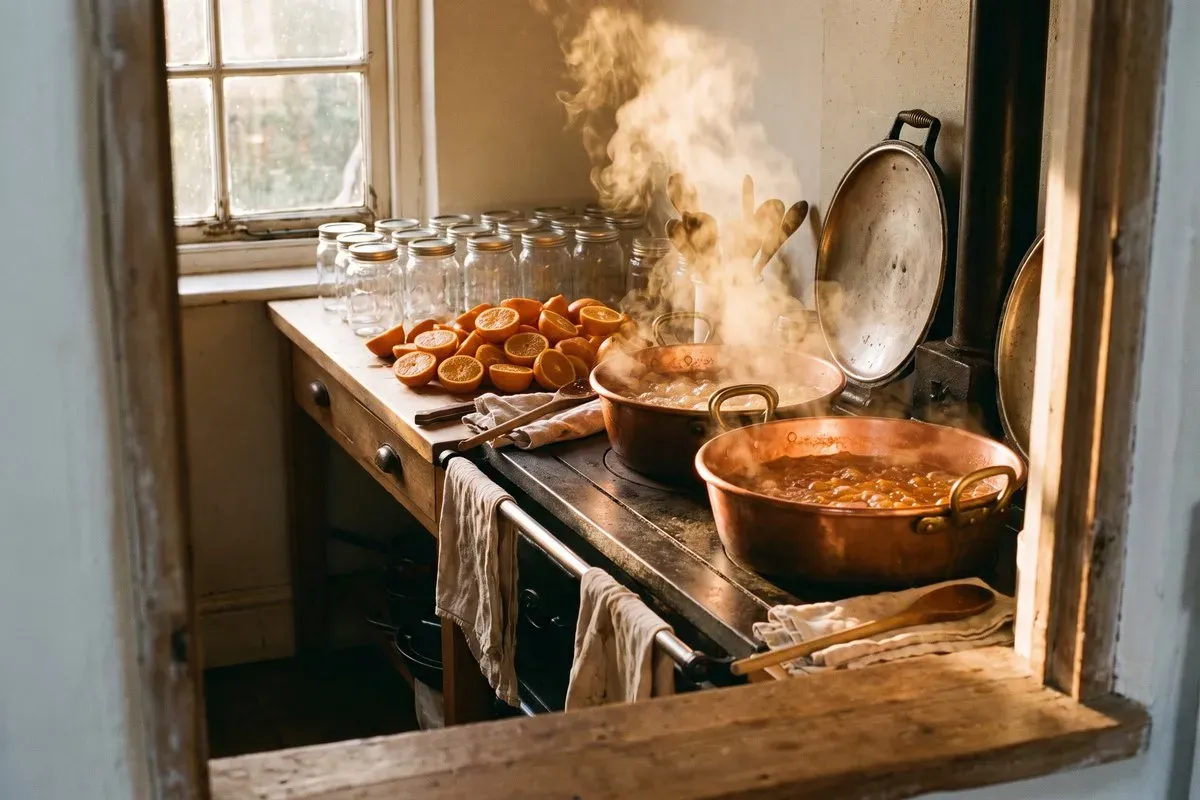
The oranges come from a growers' cooperative near Seville, small and knobbly and bitter in the best way. By six the jam kitchen is warm and Marta and Dev are already halving and squeezing, keeping every drop of juice in the pan. The peel is cut by hand, thick or fine, and left to soak overnight with the juice. The pips go into a little muslin bag tied at the top, because that is where the pectin lives, and we boil the bag with the fruit so the marmalade sets without any help.
Thick cut or fine cut
Thick cut gives you generous pieces of peel that hold their shape and taste properly of Seville orange. Fine cut gives you delicate shreds that spread smoothly and set a little firmer. We make both, and the only real difference is time and a steady hand with the knife. If you are not sure which you like, buy a jar of each and eat them on the same morning, which is exactly what we do when a new batch comes off the pan.
The wrinkle test
Everything boils in wide copper pans, which spread the heat evenly and let the fruit move. The sugar goes in once the peel is soft and we stir until it has dissolved, then turn up the heat for a hard rolling boil. To test the set, spoon a little onto a cold saucer from the freezer and push it with a fingertip: if the surface wrinkles, it is ready. Then it is potted into warm jars, about forty jars a pan, and the first ones are on the shop counter by the afternoon.
Across the season around 600kg of oranges become about 2,000 jars, which just about lasts us the year. The deli began in 2012 with a chutney stall and marmalade followed that first winter, so January still feels like the true start of things here. Come by on a Tuesday and there will be a spoon out for tasting.